
The Construction Labor Shortage Is Already Here: What It Means for Investors and Developers
The construction labor shortage isn't coming.
It's already here. Has been for a while. And if you've been in the field long enough, you felt it before anyone started writing articles about it.
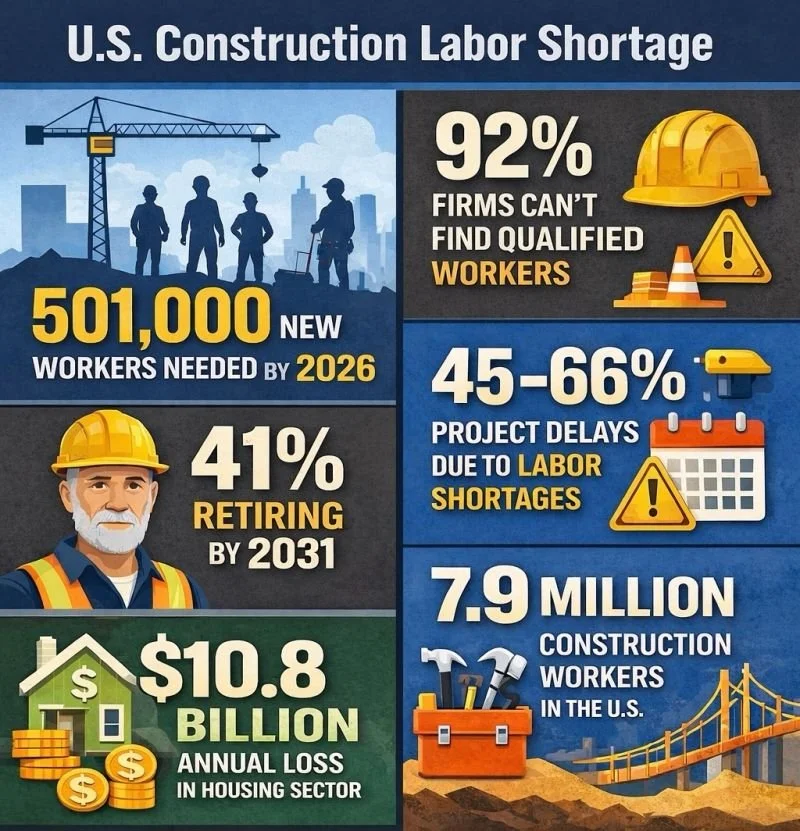
Most firms can't find qualified workers. Not because the jobs aren't there. Not because the pay isn't competitive. Jobs get delayed not because of materials or permits or some regulatory bottleneck you can fight your way through. They get delayed because the people simply aren't there. The hands. The experience. The guy who's run a crew for fifteen years and knows how to solve a problem on a Thursday afternoon without calling you first.
That guy is retiring. And there isn't a line of people behind him.
With a significant portion of the skilled trades workforce set to exit over the next decade, this isn't a short-term hiccup you can staff your way around with a temp agency. This is structural. It was built over a generation of decisions, and it's going to take more than a hiring push to fix.
Let's be clear about what this actually is, because the lazy take gets it wrong every time.
This isn't about people not wanting to work. That framing lets everyone off the hook too easily.
This is about an aging workforce that was never properly replaced. It's about an entire generation that was steered, firmly, consistently, from counselors and parents and school systems, away from the trades and toward a four-year degree that may or may not have had a job waiting at the end of it. We told a generation that working with their hands was the backup plan. Then we acted surprised when they believed us.
It's about owners who want speed and certainty without paying what speed and certainty actually cost in this labor market. It's about general contractors stretched so thin they're bidding work they can't staff because the alternative is watching someone else take the contract. It's about subcontractors carrying risk they were never structured to hold, operating on margins that assume nothing goes wrong, and we all know something always goes wrong.
The result plays out the same way on every job site that isn't paying attention to it.
Delayed projects. Blown schedules. Change orders that wouldn't exist if the right people had been on the job from day one. Burned-out crews doing the work of teams twice their size because there was no one else to call. Real money lost. Not budget variance money. Real losses that hit the investor, the developer, the owner, and the community waiting on the project.
I've watched this happen on projects I was running twenty years ago in a milder form. What I see now is the same problem with the volume turned all the way up and fewer experienced people left to absorb it.
Until skilled labor is treated like a strategic asset, budgeted for, recruited for, developed from within, and compensated like the expertise it actually represents, the cost of this shortage only increases. It doesn't plateau. It compounds.
The fix isn't a single policy or a single program. It's a shift in how the industry values the people doing the actual work. Apprenticeship pipelines that are funded and taken seriously. Trade education that gets the same institutional support as a university prep track. Ownership structures that give skilled workers a reason to stay and build instead of burning out and leaving.
We built this problem over thirty years. We're not solving it in one hiring cycle.
But the firms and investors who recognize it as a strategic issue right now, and staff, plan, and partner accordingly, are going to have a significant advantage over everyone still treating labor as just another line item to compress.
If you're working through labor challenges on a development or trying to underwrite realistically in this environment, let's talk. Schedule a call at calendly.com/jeph-reit